Organic Lawn Care Products and Methods for a Truly Green Lawn
Here's a short guide to organic lawn care products which will help keep your organic lawn in tip top shape.
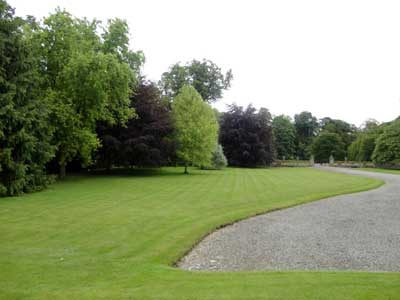
Picture: A large beautiful lawn takes a lot of work!
It would be nice to think you can leave your lawn to its own devices and let nature take its course. But a lawn is a relatively artificial environment which needs cultivation and care for best results. Lawns need to have their fertility levels replenished, especially if you are aiming to have an attractive green lawn which is a pleasure to see - and sit upon!
Dry conditions, very wet conditions, icy winters and wear and tear from foot traffic will all take their toll.
You can keep your lawn in fine fettle by by adding natural home made fertilisers such as comfrey tea or composted kitchen waste.
Or you can opt for commercial solutions to lawn care - or use a combination of the two.
Here are a few commercial organic lawn care products which will help you keep the upper hand.
Organic lawn care products to buy
A specialised organic lawn care product such as Nature's Turf 8-1-9 fertiliser is worth applying if your lawn is struggling.
A fifty pound bag will treat a lawn area up to 16,000 sq feet, depending upon the rate of application. It helps restore biological activity so it's best used in the spring. It's low in phosphorus which means that it will not encourage weed growth in your lawn.
There are also special lawn fertilisers for autumn use. Try Natural Gardening's Autumn Lawn fertiliser which is designed to help stimulate root growth. It contains rapeseed and prairie meal, kelp meal, lignite, rock phosphate and mined sulphate of potash. These are all natural and organic products and suitable for use by vegetarians, too. From the Natural Gardening website:
"The ingredient lists of many commercially available products read like the contents of a slaughterhouse: - blood meal, meat and bone meal, feather meal, fish meal, hoof and horn meal and various animal manures. The increasing concerns associated with some of these materials e.g. BSE, Foot and Mouth, Salmonella and E.coli infections has lead Thomas & Fontaine Ltd to develop the Natural Gardening range of organic fertilisers based upon plant materials."
Whatever product you choose, with care and persistence you can create a beautiful lawn using just organic techniques. Read on below for details on how to use seaweed extract.
Organic lawn care products:
Seaweed extract - a natural organic lawn care product
Seaweed extract is a valuable tonic which can benefit your lawn.
Seaweed is very rich in micro-nutrients and trace elements. The alginic acid found in seaweed also helps conserve moisture in the soil - a useful fact, given that some many of us are struggling with watering bans and drier summers. It also helps with crumb structure of the soil.
Seaweed extracts can temporarily deplete the nitrogen in the soil - this is because the seaweed takes up available nitrogen in the process of breakdown. However, in the long term there is a net gain in nitrogen. The moral of this tale is: don't add seaweed extract the week before your lawn plays host to a wedding party and expect it to be looking its best! Seaweed can take as much as 15 weeks to create noticeable benefits for your lawn.
You can counteract this temporary effect by adding a more instant nitrogenous lawn feed at the same time.
In Britain, you can buy seaweed extract under the trade name Maxicrop which is available in most good garden centres or you can buy calcified seaweed from Chase Organics. It's not really practical for most of us to harvest our own seaweed. Seaweed was traditionally used by crofters in Scotland to grow crops on the windswept rocky islands.
6X Lawn Feed is a good organic lawn care product which is based on animal manure and is specially formulated for lawns. I've used 6X fertiliser products myself and found them good.
Organic lawn care products:
Dry fertilisers
Dry fertilisers such as Fish, Blood and Bone can be used on your lawn. With dry fertilisers, even the organic ones there is an increased risk of leaf scorch. You can't just move grass leaves out of the way! The best advice is to use dried products very sparingly and preferably water them in immediately.
Use all fertilisers when the ground is already moist - you will have a better take up and less risk of scorching.
Bone meal, dried blood and hoof and horn
Other dry organic fertilisers include bone meal, dried blood and hoof and horn.
Bone meal is made from dried, steamed bones from animals that have been slaughtered. It is particularly rich in phosphorus.
Horn and hoof is richer in nitrogen and has the added advantage of being relatively slow release. It can promote growth of leaves and roots for as long as a year after application but it is relatively slow to start to act - several weeks, usually.
Dried blood is high in nitrogen and can therefore cause leaf burn if added too close to emerging new growth. It is a valuable addition to compost as it tends to activate it. It is best to mix it in to soil or compost if you are thinking of using it to promote your lawn's growth.
There are also vegetarian alternatives available. In view of the animal care disasters of recent years you may feel more confident about safety (and ethics) using these products, even if you are not vegetarian. Of course the animal products are sterilised effectively.
Pelleted chicken manure
Pelleted chicken manure is probably too strong for most lawn use.
If you consider it, crush the pellets in some water and apply plenty of extra water to make sure that the manure is well distributed. Chicken manure from factory farms is pelleted - so this is perhaps not the most ethical source of fertility for your garden. It is possible to find organic chicken manure pellets, from organically raised flocks.
Most of these animal-based organic lawn care products and fertilisers can be found in any large garden centre or on line from specialist garden outlets.
For vegetarian options, see the information about seaweed products, above.
In the US, Espoma 20 20 All Season Lawn Food has no added phosphate and is completely organic. I cannot comment on its usage as it is not available in the UK but it seems to have pleased at least one user.
Jobe's Organic All Purpose Granular Fertilizer has had great reviews but it is not specifically for lawns. It's a powerful and effective fertiliser but one or two reviewers did mention the rather powerful smell! Again I haven't tried it but in my experience the smell from organiic fertilisers does recede quite quickly, especially if you take care to water or rake them in. This product contains Archaea which are microorganisms similar to bacteria that break down organic matter exceptionally quickly. This is what accounts for the rapid action of this product.
See the side panel for more ideas from Amazon.
Sponsored links
Organic lawn care products:
Want to do it yourself?
Here are a few ways to enhance vigour and fertility in your lawn without using bought natural organic lawn care products.
Bokashi
Bokashi compost juice or tea is the liquid which is created during the composting process. Every few days you drain off the liquid. It is a rich, yeasty brew which stimulates bio activity in the soil. If you are already using a bokashi composter, then this is a free by-product. Use it diluted on your lawn and garden.
Bokashi composting is an easy and fun way to compost virtually all your kitchen waste. If you haven't come across these marvellous devices, read about them here: Bokashi Kitchen Composters This is a fantastic way to get first rate soil improver from your kitchen waste as well as a powerful soil stimulant which can be used almost anytime.
Comfrey tea and nettle tea
Comfrey is the most amazing plant. Aside from its medicinal properties it has an invaluable role in your garden. It's a big, bossy plant so it needs to be kept in bounds, preferably in a far corner where it cannot spread too enthusiastically. The real value for the gardener is in the tea.
Make some tea
You can make comfrey tea very simply by placing a small sack of chopped comfrey leaves into a tub of water. The proportions are about 14 lbs to 20 gallons of water but as long as you dilute the liquid feed down enough the exact proportions are not too crucial. Leave the mixture for up to 3 - 6 weeks. You can start using it within a few days; it just keeps getting better as time goes on. If you can aerate the mix from time to time it helps. It will smell vile so keep it away from the kitchen door!
Dilute the resulting liquid until it is a thin tea colour and water it onto your lawn - or anywhere. It is very rich in nitrogen and potassium - but not so rich in phosphorus, so it is ideal as an occasional lawn feed. In fact, it is richer than farmyard manure.
Read more about using and growing comfrey here.
Or check out this page from GardenOrganic
Nettle tea
Nettle tea can be used in exactly the same way and has the added advantage that the nettles are coming on strong a little earlier in the year than comfrey. It can be gathered as part of the early spring weeding and soil preparation. Just throw it into a bucket and add water. Soft water from the water butt is best. Dilute to the colour of weak tea to use. This must be the easiest of organic lawn care products!
Return from Organic Lawn Care Products and Methods back to Green Garden - Organic Gardening
Greenfootsteps Home - for more easy green living ideas
Organic Lawn Care Products
Copyright Greenfootsteps 2010
| Tweet |
 Subscribe to the blog


| Tweet |

On other pages:
Sponsored links
Footprints
- an occasional e-zine from Greenfootsteps
If you would like to receive the e-zine, please just sign up below.

New! Comments
Have your say about what you just read! Leave me a comment in the box below.