Water Butt Choices
How to choose a good rain butt for green gardening
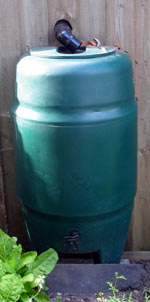
A well chosen water butt can collect water effortlessly for your garden. A good water storage system is a benefit to any garden and the simplest way for most people to collect water is to take it from the roof.
Almost any roof presents a large surface area to the elements and will perform the job of collecting rainfall. You just need efficient gutters, down pipes and some rain butts. Even relatively dry parts of Britain such as East Anglia receive as much as 20 inches of rainfall per year. Multiplied over the area of an average roof this results in thousands of litres of rainfall which can be collected. Most properties have gutters and down pipes already in place so all that needs to be done is to choose and install suitable butts.
However, not all rain butts are the same. So what's to choose between them? What should you look for in butt design and which styles are the most efficient and practical? This page attempts a few answers to these questions, from a green living perspective.
Picture: A rain butt that fits flush with the wall
Water storage choices - what to consider
Size: bigger is usually better!
It's worth thinking a little about aesthetics if the water butt is going to be visible and on a corner of your house. Check that the scale is appropriate. A very large water barrel can look absurd attached to a small or low level dwelling. If you need to store a lot of water you could consider installing an underground tank.
Other than that, the bigger the better because you will always find some use for soft rainwater which costs you nothing (as against hard, chlorinated tap water).
Water butt choices: Materials
Most water storage butts are made from rigid plastics. Some are made from recycled plastics which makes them a little more environmentally friendly. Wooden butts do exist but are relatively expensive and may require some maintenance. You also may need to fit a drain diverter yourself.
You can buy a variety of rain barrels from Amazon but I haven't tried any of them myself as yet.
Make sure that the water butt you choose is sufficiently strong to do the job; water is heavy and cheap plastic butts can be distorted by the weight of water within them. A container which needs no separate lid because it is almost enclosed is best for strength.
A butt with a separate lid may distort so that the lid does not fit easily or well. It may also come off or be left off, leading to the possibility of small birds or animals drowning in the water, or the water becoming clogged with debris such as leaves.
Sponsored links
More choices:Designs, shapes and bases
In addition to the points above about thickness and strength, consider shape and functionality. A vertical cylinder shape is less likely to tip or pull away from its fastenings than one which is larger at the top than the bottom. Be aware of the "footprint" of the butt - i.e. how much floor space does it take up? Will there be sufficient room to move around it?
A lid or integral closure is essential. Small animals and birds - and even children - can be at risk from drowning in open water butts. If you choose a butt with a separate lid then make sure it is well fitting and has an efficient fastener. Childproof fastenings are available on some water butts.
A base which allows the butt to clear the ground with enough room to get a watering can under the tap is a good idea. You can always mount the butt yourself on bricks or breeze blocks but a bought base is easier and neater. More than one tap can be useful, especially if there is more than one access to the butt. An overflow system is also a good idea. Even better is a diverter (rain saver or rain trap) attached to the down pipe. This lets surplus water go down the drain or soak away once the butt is full. Some models come with this as standard.
Water butt choices: Colour and style
It's worth considering colour in relation to what else is in your garden or in relation to the colour of your house. Most rain butts come in muted colours though I have seen some slightly garish two-tone affairs!
A dark colour should help slightly in keeping the temperature up in winter.
There are now many styles and shapes to choose from. Wine barrel shapes and Roman columns are possible if you like that kind of thing and even Moroccan beehives have put in an appearance. These can all be ways of giving a fantasy element to garden design.
At the end of the day the style is immaterial from a green perspective as long as the design is functional.
Water butt choices: Installation
Make sure that your down pipe is your own before installing that fancy, expensive water butt. Ask your neighbour's permission in advance if there's any question of shared space.
Also, think about the access route to the site if you are choosing a large rain butt.
Make sure that the ground supports are more than adequate and that there is no local subsidence or instability in the ground where the butt is to be installed.
Green Garden - Organic Gardening is Green Gardening
| Tweet |
 Subscribe to the blog


| Tweet |

Sponsored links
Footprints
- an occasional e-zine from Greenfootsteps
If you would like to receive the e-zine, please just sign up below.

New! Comments
Have your say about what you just read! Leave me a comment in the box below.