Auto Fuel Economy - Reduce Your Car Use!
Some simple ways to auto fuel economy!
We have already considered the best ways of increasing fuel economy for your car.
Now it's time to look at painless ways of reducing car use. Here's a brief guide to auto fuel economy through reduced usage. If you live in a town or city some of these ideas can be quite realistic. Even rural dwellers may find some useful ideas below.
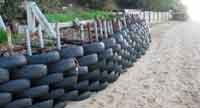
Picture above:
Recycled tyres used to create a sea wall; waste tyre dumps can create environmental problems as they are not so easy to recycle
Auto fuel economy - ways to cut your car use and still get everything done!
Buying a second hand car can be fraught with dangers. And new cars are hideously expensive for most of us, even if we don't need to access finance.
Once you've bought your car, paid the tax and insurance and maybe HP payments, paid out more cash for servicing and maintaining it, it seems crazy not to use it at every opportunity. And many people, especially new drivers, just love driving and will think nothing of driving five miles just to buy ice-cream or a six-pack!
But with the spiralling cost of petrol and the knowledge that every journey contributes to climate change, many people now want to reduce their car's mileage any way they can.
Already, in response to the credit crunch, motorway traffic is down - in Britain, around 12% according to a report by Trafficmaster and the RAC Foundation (2008).
Now, at the close of 2011, car sales remain down and road traffic is decreasing slightly again in the face of fuel price rises. Despite a growing population, the amount of traffic on Britain's roads fell by around 2% in 2010, according to the Transport Research Laboratory.
Carbon car-print?
But there's more to be done, with or without economic pressure. Transportation accounts for around 24% of people's carbon output in the UK - and other developed nations are similar - so it's a worthwhile thing to reduce. According to the WWF, the average person can save around 20% of their carbon emissions by just not owning a car.
It's interesting that government statistics show that we are already travelling slightly less distance by car as compared to 1998 - 2000. Certainly, car driving seems to become less attractive year on year, with increased road restrictions and numerous tailbacks and jams. Road congestion is perceived as an ever-growing problem. It can certainly ruin an outing or add unnecessary stress to a busy working day.
So here below are a few pointers to this particular method of achieving auto fuel economy i.e. stepping out of our personal car and trying some alternatives!
Other pages related to auto fuel economy which may interest you:
Hybrid Car Advantages for a 21st Century Ride
Cash for Clunkers and Scrappage Schemes
Here are some good books about car use and and auto fuel economy.
Auto fuel economy - ways to cut your car use:
Lift share schemes
The biggest lift share scheme I've found is called just that Liftshare.com.
The idea is simple. You log the details of the journey(s) you want to do and you log details of journeys you can offer. Other people who have registered can then look. You receive or make offers for lift sharing. The way this works best is for regular journeys, commuting to work being the obvious one.
The software is pretty good and the interactive map helps a lot with planning journeys and seeing who is nearby. The only problem with it is that there does not seem to be any way of expanding your profile so that people can get a sense of who you are (in order to build up trust).
Many on-line communities now offer this kind of thing. Done well with some additional verification strategies, it can help people to feel confident when making arrangements on-line.
You are able to access people's phone numbers if they have entered them, so you can speak directly to them about your journey needs. If they have not, you will receive requests and offers through the system. You can look at other people's planned journeys on a map display or on a chart which lists likely matches.
There are now more than 250,000 registered users of Liftshare.com and the number is growing fast.
You can ask for a contribution towards petrol but it should be realistic, not exploitative! Anything else could invalidate your car insurance.
In the UK there are also some schemes which are more tailored to local needs. carshare2cardiff.com is one example. Quite a few local authorities organise car share schemes, some through organisations such as liftshare.
At PickupPal drivers and passengers log their requirements and the organisation finds matches between people. They also run a feedback system so that both drivers and passengers can build a good reputation with the on-line community. Unfortunately, some bus operators are trying to shut down car share schemes in their areas. Ontario is a case in point: see the Pickup Pal website for more details.
Informal sharing arrangements
How much do you talk to your neighbours?
If you have friendly neighbours it's easy to set up informal agreements where you pick up shopping for each other, or even borrow each other's cars.
It does not always cost much, if anything to add a named driver to your insurance, provided that they are an experienced driver with no insurance claims or accidents to their name.
This type of informal arrangement can be very beneficial for people in relatively isolated rural areas and it can work in town, too.
Busy parents often share lifts for their children to and from school, saving time and money. Extending this to other age groups should not be difficult. It already happens in some communities where "good neighbour" schemes and the like have been started.
Auto fuel economy - ways to cut your car use:
Car share schemes or car clubs
This can suit some people. For many it's an alternative to car ownership. As such, it will almost certainly slash your car use, delivering auto fuel economy as a by product!
With a car share scheme, you register and get a smart card and a security number. You need to plan your journeys ahead and book your car. You pick it up from a pre-agreed parking spot and just swipe your card on its card reader.
Whizzgo operates in many cities in the UK, including London, Birmingham and Belfast. They have taken an idea that has been proven to work in the USA and Europe and extended it to Britain. There are dozens of pick up points all over central London and Whizzgo cars are exempt from the traffic congestion charge for central London.
What does it cost? You pay per use and you pre-book your time by phone or on-line. Use is charged by the half hour and the minimum use is for one hour. You pay an annual fee of just under £50 and journeys are priced at around £5 per hour with reduced rates for longer times.
Some petrol consumption is included. See the website for exact charges as they vary slightly from city to city. There also deals for corporate users and frequent users. Corporate users benefit because using Whizzgo enables them to maintain a smaller pool of cars and perhaps enable some employees who use cars during the working day to use public transport to get to work. People living at the same address can benefit from reduced membership fees if they share a smart card.
Are there any restrictions? You cannot carry pets and no-one can smoke in the car. Other restrictions are fairly much common-sense ones. For example, you must not let anyone else drive the car and you must return it in a clean condition. One other innovative thing they do at Whizzgo: if you are 18 and you have been driving for more than a year you can be a member. (Hiring a car for this age group is usually very difficult and insurance costs can be prohibitive for 18 year olds wanting to run their own car.) Insurance costs are included in the hire charge.
Streetcar runs a similar outfit which mainly operates in the south of England. The prices are very similar to those of Whizzgo. If you want to see a short video of the scheme in operation go to this: streetcar page and scroll down to the video link.
Some great reading about cars - and bikes
Here are some great books about cycling and the cult of the car - and even a bit of philosophy about restructuring society some.
It's Not About the Bike: My Journey Back to Life Here's the story of Lance Armstrong who overcame cancer and won the Tour de France cycle race. A life-affirming story of gritty determination and courage.
Traffic: Why We Drive the Way We Do (and What It Says About Us) This book has been called the "Freakonomics" of car use. A surprising and fascinating look at some of the psychology behind driving patterns. Would you believe that cars drive closer to cyclists who are wearing helmets?
Hot, Flat, and Crowded: Why We Need a Green Revolution--and How It Can Renew America Thomas L. Friedman looks at the twin crises of modern America - and the world. The loss of focus and direction for our economies and culture and the problems of climate change.
Car free (carefree?) days
16th - 22nd September is European car free days.
"In Town Without My Car" is a concept which has been developing and expanding since 1995, when a small group started in Bath, UK.
Now over 2000 towns worldwide participate. The idea is to promote car free days when many methods of green and people friendly transport are available. The days can be used to test plans for future methods of controlling car use and promoting alternatives.
If you want to watch and see how much fun it could be to have a car free day in your town take a look at this video of New York' "Summer Streets" initiative.
There are lots of short videos on Youtube of people celebrating car-free days. Too many to list here! Car-free days are a great way to start to home in on auto fuel economy.
On ya bike!
There are plenty more ways to cut your car use.
The obvious ones are cycling, walking and using the bus. How useful these are to you depends very much on your personal circumstances, so I won't you bore with their virtues here!
If you are interested in the health and well-being benefits of walking visit this page: The benefits of fitness walking. Please also explore the other articles in this section for more auto fuel economy ideas.
There is also a new movement in Belgium to get people to do short trips by bike. This can work well, if your local cycle routes are safe.
*****
Return from "Auto Fuel Economy - Reduce Your Car Use" back to Green Car - "Transport and Fuel
"
Greenfootsteps Home - for more easy green living ideas
Auto Fuel Economy copyright Greenfootsteps.com, 2009.
Please do not copy without permission.
| Tweet |
 Subscribe to the blog


| Tweet |

What our readers say...
I've just fallen into your website and wanted to say how great it is!! I've got a lot of cheap ideas and when you're on a tight budget - that's vital! - Gail, NZ
Your site has been an exceptional resource as I have sought to modify my lifestyle. - Art, US
Just a big thank you for all the info! - Estelle, US
Loved your simple, clear approach. Thanks for the many great tips. - Laura, AUS
I found your Web site fascinating... - Steve, US
Footprints
- an occasional e-zine from Greenfootsteps
If you would like to receive the e-zine, please just sign up below.

New! Comments
Have your say about what you just read! Leave me a comment in the box below.