A Healthy Living Diet - for Us and Our Planet
If you want to be greener, eat organic!
This page looks at what a healthy living diet is both for us humans - and for our planet home. There's an explanation of why organic growing is better for our health and for our long term survival and why it is better for wildlife and biodiversity. Organic growing is also far more sustainable as it does not rely so much on dwindling supplies of fossil fuels for its production.
For all these reasons organic foods and organic growing methods are strongly supported by most people interested in green living.
Help yourself to health!
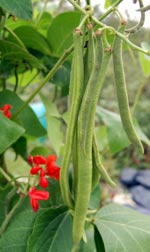
Many people believe that there's not much more to organic food than a heftier bill at the till and more blemishes on the produce. But there is a lot more to organic food. Organic food is often tastier, has considerably more nutrients and contains far fewer harmful residues.
A really healthy living diet contains plenty of organic foods - foods produced without the aid of artificial fertilisers and without the use of pesticides and herbicides.
Picture: organic runner beans - attractive and nutritious.
Eating healthy food is important for most people. But there is much debate when it comes to deciding what is and what is not a healthy diet! One thing is sure: healthy diets are diets based around lots of fresh, raw and lightly cooked natural foods, foods which have been grown in a rich, living soil. In short, organic and near-organic foods.
Crops grown with successive sprays throughout the growing season may taste OK and be reasonably residue-free - but there will always be a question mark. How can you really be sure there are not chemical residues from sprays?
And, in weighing up your need for a healthy living diet - you might also want to consider the long term effects upon the earth - soil fertility, wildlife and the depletion of irreplaceable resources.
Organic food is grown by natural methods, many of which have been around for centuries or even millennia.
On the whole, organic food is safer for people and animals to eat.
Click here for recommended books on growing food by organic methods
A healthy living diet:
Building fertility and disease resistance
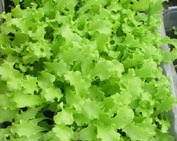
Organic farmers and horticulturists use only natural fertilisers such as manure and compost. Natural fertilisers improve and nourish, the soil. Tiny organisms in the soil break down the fertilisers, much as the stomach digests food so that the body can use it. The growing plants are able to take their nutrients directly from the soil.
If organic farming is done well the foods produced are free from chemical residues. They are strong and disease resistant, full of trace elements and vitamins, and exceptionally tasty.
Picture: Endive seedlings grown in organic potting compost
Tasteless and nutritionally deficient foods anyone?
By contrast, many artificially grown vegetables are often fairly tasteless and are deficient in some of the smaller nutrients (for example, zinc and boron). Nutritionists are becoming more aware of the role played by such trace elements in health. Selenium, for example, helps protect against cancers. And zinc is important for immune function and helps prevent the common cold.
Meat always used to be a good source of zinc. Now grazing land is often so depleted of nutrients that there is scarcely any zinc present in animals reared on such pastures.
Worse still, many beef cattle are reared in intensive conditions and fed on high protein diets based on maize and other grains. This unnatural diet is a far cry from the rich, dense pastures favoured by the best organic farmers. The resulting meat is high in fat and contaminants. Not at all a healthy living diet for people - and crazily unsustainable because of the huge energy inputs involved.
Grain-fed beef may even be a real health hazard as it is high in Omega 6 fatty acids and low in Omega 3s. The consumption of high fat grain-fed beef has been linked to increased heart disease and cancer in humans.
There have been recent attempts to create factory farms for dairy herds, too. Nocton Dairy, in Lincolnshire, England, would have become an intensive unit where cows rarely went outside during their productive lives. Fortunately the Environment Agency responded to public concerns and stopped the venture. There are plenty of issues surrounding modern dairy production already. A healthy living diet is best achieved by limiting dairy food to a small part of the weekly food plan, especially if like many people, you are at all intolerant of dairy foods.
Or what about a chemical cocktail?
Chemically grown plants are helped to survive against predators and disease by frequent spraying with pesticides. Some of the pesticides used end up - in tiny amounts - in your dinner. This might not matter if they were not toxic – but they are. Any chemical can be toxic if you give it in a large enough dose. But these chemicals are designed to be toxic (generally to kill pests) and often they are toxic even in quite tiny amounts.
Also, the effects on humans may be hard to judge because there are many chemicals involved.
Whereas scientists may understand the actions of one particular chemical, there is huge uncertainty about how these chemicals interact with each other within our bodies. There may even be unknown interactions between such chemicals and medical drugs or chemicals used in personal care products. Recent studies have shown that common foods such as apples and carrots sometimes have significant toxic residues in them.
And you can’t just wash these residues away.
It’s a good idea to wash your apples before you eat them of course, but many residues are found throughout the body of the fruit. Carrots retain significant residues in their outermost parts, which are also the parts which have the most nutritional value.
The European Union has some of the strongest rules on permitted pesticide residues; nevertheless, evidence is building that too many residues are still remaining in foodstuffs.
In the UK, the Pesticide Action Network tested apples and found traces of 39 chemicals. The most common was Chlorpyrifos with 18% of non-organic apples containing residues.
Over half the apples tested had detectable chemical residues. Most of these were within "acceptable" legal limits (as imposed by the EU) but a few apples had as much as 4 times the legal limits. 30% of apples tested had more than one detectable chemical residue.
More and more people are turning to natural and organic foods as the health benefits become clearer. Unfortunately, economic pressures may now be making many consumers choose non-organic foods because food prices are rising and the credit crunch is persuading many people to budget more carefully.
A healthy living diet:
Why is organic food so expensive?
Unfortunately organic food is generally more expensive. The economic reasons behind this are complex. Here are a few of the reasons:
In Europe and many western countries farmers receive subsidies for using pesticides. Organic farming is more labour-intensive than modern, industrial farming. More people have to be employed to care for plants and livestock to ensure the high standards which have to be reached. In the UK for example, all organic farms have to be approved by the Soil Association before produce can be labelled as organic. The process costs time and money.
As more people turn to natural and organic foods some of these costs should come down.
See here for tips on how to find cheap organic food
If you are interested in learning more about why organic growing is best for our health and for a sustainable approach to agriculture please also see: Why organic?
The Soil Association website is well worth visiting, too for greater detail on this fascinating subject.
A healthy living diet:
The health benefits of organic foods
The health benefits of organic foods are so clear that it makes good sense to make organic foods the major part of your diet. What you lose in money you will gain in increased health and vitality for sure!
There will be other spin-offs too: fewer trips to the doctor’s, fewer days off work, fewer headache pills, fewer chronic diseases…, all of which can be costly. And of course, peace of mind that you are not slowly poisoning yourself with toxic residues of pesticides. This is the true meaning of a healthy living diet in today's polluted world.
A healthy living diet - from your garden!
Here are a few good books on growing organic food.
Growing Vegetables West of the Cascades: The Complete Guide to Organic GardeningThis book is a fantastic for people living in areas where the season starts late and the summers are short. The advice is from a seasoned grower who uses organic methods to get outstanding results.
Gardening When It Counts: Growing Food in Hard Times (Mother Earth News Wiser Living Series)This is one for people who want a grounding in traditional organic methods. The author sets great store by using traditional tools and not going for the dense (and thirsty)planting schemes favoured by many modern growers. More space may mean stronger, more drought-resistant crops. However, as with all these methods, you do need to judge your own local growing conditions and find what works for you!
A healthy living diet:
Shop locally for a sustainable food basket
Even if you don’t want to buy organic food, it is still a good idea to shop locally for food. From an ecological viewpoint, the fewer miles food has travelled to reach the consumer the better. Many supermarkets buy in fresh food from all round the world (some of it organic). While this is very impressive in a way, it is not sustainable as a major part of our shopping baskets. Such food as fresh figs or mangoes have to be flown in to consumers in cooler countries and this contributes to climate change.
It is hard to completely avoid such foods but I believe you can have a wonderful diet whilst using mainly locally-sourced foods.
Also, some exotic foods are well suited to the slower but more sustainable sea transport, so you don't have to be completely hair-shirt about it!
More and more supermarkets are selling organic produce, some of it local. Farmers' markets are springing up in Britain and the US. In Europe there are still good street markets, some of which sell organic produce. Shopping locally for most of your week's food is another way to find a healthy living diet for our planet!
So support your local farmers and horticulturists and buy your natural and organic foods locally at the street markets and farmers' markets. You can often buy local craft and art items too and some of the more developed farm shops stock other eco-friendly goods, such as non-toxic domestic cleaning products.
A healthy living diet:
Conservation grade and almost-organic farming
If you get to know your local growers you can often find people who are producing wonderful food which is organic in all but name. As the cost of registering for organic certification can be high, some growers opt for a sustainable approach without actually registering as organic. It's only by getting to know the local market and the people working in it that you can find out these things.
There are also farmers and horticulturists who adopt a compromise position: they try to grow nutritious tasty crops with a very minimum amount of chemical aid. They focus on putting fertility back into the soil and they look after their local wildlife. But they do resort to occasional sprays and chemical fertilisers in some instances. The food produced is sometimes calledconservation grade food.
I believe that this compromise position is certainly something to be encouraged as it represent a move away from the industrial approach to food production, with its reliance upon oil and gas for fertilisers. The resulting food will in most cases be of high quality, reflecting the care and expertise that has gone into its production. Local wildlife will be relatively better off, too as the soil fertility will encourage some of the insect life which is a necessary part of the food chain.
Conservation-minded farmers often plant and maintain good hedges and leave ample field margins, which can provide valuable habitats for birds and small animals. (The practice of leaving wide field margins is now being encouraged in Europe, thanks to the "Entry Level" system for sustainability.)
Natural and organic foods and conservation grade foods will become more available as the real costs of chemical farming becomes clear. Eating organic and conservation grade foods helps provide and maintain a healthy living diet for local wildlife.
A healthy living diet:
Why not grow (some of) your own?
If you have the time and the inclination, it’s fairly easy and quite good fun to grow some of your own organic foods. You can definitely save money this way as well as providing your family with fresh, tasty, nutrient-rich food. Food straight from the garden has to be some of the most wonderful, flavoursome food ever!
And of course you know it's fresh.
If you would like to learn more please go to How to grow a vegetable garden
There you will find many pages about growing simple salad crops and vegetables. I only include fairly simple, straightforward crops which suit the busy person, ones which will likely save you money as well as providing abundant, nutritious, delicious food.
You can also grow some things indoors or on windowsills. Home-grown bean sprouts can even be grown in a cupboard or on a shelf!
I hope you find some food for thought amongst these pointers towards a healthy living diet. I think we are beginning to learn that a sustainable diet is also a a diet for healthy living, not just for us humans but for our planet too.
Return from A Healthy Living Diet back to Green Kitchen - Natural and Organic Foods
Greenfootsteps Home - for more easy green living ideas
A Healthy Living Diet for a Sustainable Lifestyle -
copyright Greenfootsteps 2007
| Tweet |
 Subscribe to the blog


| Tweet |

Sponsored links
Footprints
- an occasional e-zine from Greenfootsteps
If you would like to receive the e-zine, please just sign up below.

New! Comments
Have your say about what you just read! Leave me a comment in the box below.