The Best Eggs for Healthy Nutrition
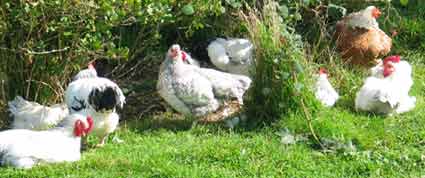
The best eggs - and the tastiest - come from healthy free-range hens!
Eggs nutrition repays some study.
The best eggs for our health are almost certainly free-range, or pastured, organic eggs from well-cared for hens farmed in a natural woodland or grassland environment.
What's here?
Here is a page about eggs and health which focuses on some of the benefits of eggs from sustainable sources. There are details of the nutrients to be found in eggs and the health benefits of eggs. There's also a discussion on why free-range and organic eggs are best for health.
The best eggs for humans and the planet do not include intensively farmed eggs such as eggs from caged hens. If you care about green living, your health and a sustainable world you will want to avoid such battery farmed eggs.
See here for more on battery farming and caged hens There are also brief details here below.
Battery eggs? No thanks!
First a very brief look at the travesty that is battery farming. Skip this if you are squeamish and just want to know about eggs nutrition and the very best eggs.
Battery farming allows inhumane and unsustainable practices. Birds are caged 24/7 in tiny amounts of space, Typically hens stand on wine mesh floors and their urine and faeces drop though the gaps to a tray below. The atmosphere is laden with the smell.
Birds are routinely de-beaked at a day old and again at 7 weeks. This is to stop them from maiming each other in the overcrowded and stressful conditions in which they live. Nevertheless, many birds are injured. Laying hens are prescribed antibiotics as a precaution against disease - because the crowded conditions are a perfect vector for disease. These antibiotics can show up as a residue in the eggs from battery farms. Chickenfeed is often unnatural and low grade (sometimes even including recycled meat and even chicken products).
Alright, enough horror stories. It is hard to sustain the belief that the best eggs can come from such a system! (They don't.)
If you are not already convinced, then maybe the nutritional benefits of free-range and organic eggs will convince you to give battery products a miss.
The best eggs money can buy
The people at Mother Earth News conducted trials of free-range eggs versus factory farmed ones. They have consistently shown that the nutritional value of free-range eggs is higher than that of battery eggs. The birds are less stressed, there is less cholesterol present in the eggs and there is more protein and other nutrients.
The egg is a wonderful thing. It is almost the perfect source of protein for humans, as its constituents are so similar to those of our bodies.
Much like ourselves, eggs are made up of around 75% water. Most of the protein is stored in the white but there is also some, plus valuable fats and vitamins in the yolk. Eggs are a valuable source of lutein and tryptophan, essential amino acids (a type of protein) which everyone needs to get from food.
High cholesterol?
There used to be concern in medical circles that consuming too manyeggs was one of the main causes of the heart disease epidemic which has afflicted many countries. Eggs were suspect because of their cholesterol content. This resulted in Britons and others being urged to cut their egg consumption to one or two eggs a week.
We now know that these fears are groundless. (The rest of the traditional British breakfast of bacon, sausage and eggs, including the fat it is fried in, is more culpable, however.) Countries which enjoy a high-fat diet will continue to suffer problems with excessive amounts of heart disease.
The Food Standards Agency in the UK now sets no recommended limit for people's egg consumption. Most of the cholesterol found in egg yolks is not absorbed by the body and has no adverse effect upon our health.
"One of the causes of high blood cholesterol levels among people in the UK is eating too much saturated fat. The cholesterol which is found in some foods such as eggs, liver, kidneys and some types of seafood e.g. prawns, does not usually make a great contribution to the level of cholesterol in your blood. It is much more important that you eat foods that are low in saturated fat."
- The British Heart Foundation
Only people with familial hypercholesterolaemia - an inherited tendency to dangerously high levels of cholesterol in the blood - need to limit their egg consumption. Fortunately this is fairly rare.
Egg eating problems
Nevertheless, many people do have other problems with eating eggs. They are notoriously "binding" (i.e. if you eat too many, you can become constipated.) This problem can be alleviated to some extent by eating a diet which is exceptionally rich in vegetables, fruits and fibre. Anyone who has tried egg white for a face treatment will understand the sticking power of egg protein! Eggs are used in many recipes partly because they are so good at sticking things together.
Constipation from eating too many eggs will be far less likely to happen if you are eating a diet which is high in fibre from such foods as vegetables, fruits, complex carbohydrates and beans. Stick to sensible dietary guidelines and you should be fine - even if you do eat a lot of eggs occasionally.
Please see Healthier Diet Advice for more on the elements of a good, no-fuss diet for greener living.
Allergic reactions to eggs
Some people may be allergic to or intolerant of egg protein. This can result in a wide variety of symptoms; if you are one of these people you may have no alternative but to avoid eggs. Fortunately there are some suitable substitutes for many purposes. Gram flour (chickpea flour) can easily replace eggs in pancakes and cakes, for example.
Vegans make cakes without eggs by using a combination of vinegar and raising agents to replace them.
Free range eggs - nutrition for health
Eggs provide a good many vitamins and minerals. Some of the outstanding ones include Vitamin A, Vitamin B12, Riboflavin (B2), Folate (important especially for women during pregnancy) and iodine. Eggs contain all the amino acids which the body needs for health.
Most of the fat which eggs contain is not saturated fat.
Eggs are a good source of lutein, an antioxidant which will protect the eyes against macular degeneration and guard against aging.
Eggs and breast cancer and other health benefits
Women who eat at least 6 eggs per week have a 44% lower risk of breast cancer according to one study.
Eggs promote the health of hair and nails. They are rich in sulphur.
You can now buy eggs which are especially rich in Omega 3s because the birds have been fed on flax seed. They are not necessarily nutritionally superior in other ways.
Eggshell membranes are being used to reduce inflammation in arthritis and joint pain. Eggshell membranes - the thin inner skin - contain elastin and have been shown to help promote healthy cartilage in humans.
Where to buy the best eggs
It is always worth looking for top quality eggs from local free range farmers who know their business; the best eggs money can buy are not necessarily the most expensive. I always notice the brilliant, rich taste of eggs from hens which have been reared outside, in the traditional way. It's important that such flocks have access to rich natural sources of food. Over-stocked outside pens will result in poorer egg quality as well as more stress and disease for the flock.
Cage-free eggs are just a starting point. If you want to get the best eggs for your health always avoid battery farmed eggs and eggs from intensive and inhumane systems and look for top quality eggs from organic farms.
According to Dr Mercola, in the USA grocery store eggs are subjected to processing with chlorine and other cleansing methods which damage them. Like skin, eggshell is a porous substance and these processes will affect the quality and integrity of the egg inside. For this reason you are almost certainly better off buying from the farm! The traditional way to prepare eggs for sale is to give them a gentle wipe with a damp cloth so that any surface dirt is removed from the shell.
Sponsored links
Best eggs - from your own flock
An even better approach may be to raise your own hens and produce your own eggs. If you have the time and a bit of space, this can be very satisfying. And hens make great pets, too.
It is sometimes possible to re-home battery farmed hens to give them a new lease of life and freedom. Most battery farmed hens do not last more than a year or two before they are culled to make way for more productive birds. But hens can live many years and be reasonably productive.
Raising chickens successfully requires thought and commitment and some investment in good housing and other equipment. You can find out a good deal at Back Yard Chickens
The very best eggs may come from the hens in your own back yard; but if that does not suit you, then know your source. Organic free range eggs are generally the best available - but even organic egg producers vary in the quality of their product. Laying hens do particularly well if they are kept on grassland or have access to wooded areas, rich in natural bug life.
For the very best eggs it's good to visit the farm and see for yourself that the birds are well kept, clean and happy. Some farmers are more than happy to let you see their flock - after all, they are generally outside during daylight hours.
Please see Battery Farming v Happy Hens for more on why you should shun battery farmed eggs.
For an excellent article on organic and free range eggs as produced in the USA, please see: The Best Organic Eggs and Why by Pat Spence.
*****
Best Eggs for Healthy Nutrition - Top of Page
Natural and Organic Foods
Greenfootsteps Home - for more easy green living ideas
The Best Eggs for Healthy Nutrition - Copyright Greenfootsteps.com 2008
Please do not copy without permission. This site is protected by Copyscape
| Tweet |
 Subscribe to the blog


| Tweet |

Other pages you may like:
Great cooking methods to live by
Footprints
- an occasional e-zine from Greenfootsteps
If you would like to receive the e-zine, please just sign up below.

New! Comments
Have your say about what you just read! Leave me a comment in the box below.