Industrial Pollution Causes Land Pollution
There are many industrial pollution causes.
This page details just a few of the main ones.
“Pollution is nothing but the resources we are not harvesting. We allow them to disperse because we've been ignorant of their value.”
- Richard Buckminster Fuller
Industrial pollution is clearly one of the biggest contributors to our polluted landscapes, at least here in the west. There are plenty of causes of land pollution, from urban and industrial ones, to rural and agricultural sources.
But which kinds of land pollution are the most important? And what can we realistically do to help prevent more pollution?
This part of the site gives an overview of some of the most important causes of land pollution, including industrial pollution.
There are also some recommendations for helping avoid domestic land pollution incidents.
Industrial pollution causes land pollution:
Industry, building works and pollution
Many industries are responsible for discharging waste into water supplies and into the air. A less obvious hazard is the pollution of the ground beneath their structures and storage areas.
When factories are decommissioned from use there is often a lengthy and expensive clean-up needed before the land can be re-used.
Here in the UK and in many industrial nations new land for building homes and schools is hard to find. In Britain every major urban area is surrounded by a "green belt" of agricultural land which is supposed to be safe from most kinds of development.
This means that "brownfield" sites are now the best choice for most new building developments. Brownfield sites are land which has previously been used for heavy industry or other buildings.
Contamination is common.
Industrial pollution causes land pollution:
What causes industrial land pollution?
Three kinds of industrial pollution causes affecting urban land
The contaminants found on urban brownfield sites are broadly of three kinds:
construction debris
petrochemical contamination from transport and fuels
heavy metals and chemicals discharged or left behind by industries.
Construction and demolition debris has to be sorted and removed. Currently, much of it ends up in landfill sites where it may pose problems.
There are many new initiatives to increase the recycling of demolition debris and so reduce the pressure on landfill sites.

Picture: building sites are often a source of industrial land pollution.
Standards are rising as more brownfield sites are chosen for redevelopment.
Industrial land remediation
There have been cases where land redeveloped for housing has been found later to be heavily polluted with toxic wastes left behind from industry. In some cases families have had to contend with pollutants in the very ground that their homes and gardens were built upon and where their children play.
Checks have to be made for heavy metal and petrochemical contamination before land can safely be re-used.
In Britain, the Environment Act of 1995 targeted the legacy of land contamination from the Industrial Revolution. It allows the identification and remediation of land which poses "unacceptable risks" to human health and/or the wider environment. Many other post-industrial nations will have similar initiatives in place for undoing soil pollution.
There are limits to this "remediation", however.
Land is only brought up to a standard acceptable for its intended use. This means there is still plenty of industrial waste buried under the concrete of parking lots and the like. This might not matter in some cases but some such pollutants may have unlooked for long-term effects. Real pollution solutions may involve far tighter regulations and more protection against pollution happening in the first place.
The fact is, even in wealthy developed countries, there are many instances of irresponsible industries leaving clean up operations to be funded by taxpayers. Irreparable long-term damage is often caused to delicate eco-systems; witness the case of tar sands oil extraction in Canada.
Industrial pollution causes in developing nations
Many developing nations are not so well protected and uncontrolled industrial pollution is still going on. This lack of regulation is often exploited by industrialised nations which simply export their problem pollutants to third world countries.
This means that many developing nations have a double burden of pollutants which affect vulnerable people who have little in the way of health care or workers' rights to protect them.
Industrial pollution causes land pollution:
Testing for pollutants
Testing for pollutants is becoming more sophisticated and some equipment is portable. Assessments can be done for land pollution at multiple points so that 'hot spots' are found quickly, and results are available immediately. This speeds up decisions about how useful land is for the people intending to use it. If soil pollution is revealed, remediation can sometimes be undertaken.
The most popular instruments are X-Ray Fluorescence (XRF) instruments for metals contamination detection and PID gas detectors for hydrocarbon pollution.
Industrial pollution causes land pollution:
Mines and factories as pollution sources
Mine works can act as a source of land pollution.
Heavy metals such as cadmium and lead may be deposited locally. Other metals such as copper may be deposited in unsafe amounts. Some of these toxic metals accumulate over time. Some deposits may take thousands of years to disperse naturally to safe levels.
Metal recycling facilities can also account for some land pollution incidents.
Many factories still release pollutants into air and water supplies; some of these pollutants can also affect the land. You might think that these issues were largely under control by now in the west.
Unfortunately, there are political pressures at work, too. For example, the EPA (a US government body) is proposing to limit the amount of information that companies are required to give about the hazardous chemicals they release.
If they get their way, this would limit an important way of reducing industrial pollution and protecting public health.
Want to read about industrial pollution and industrial pollution causes?
Moving Mountains: How One Woman and Her Community Won Justice from Big Coal Here's a searing tale of human resistance against an industrial giant. One woman and a small community in West Virginia stood out against the mighty strip-mining enterprise that wanted to slice the top off their local mountain!
Waste Land: Meditations an a Ravaged Landscape Stunning photographs and commentary on the environmental destruction of the American continent. By renowned photographer David Hanson.
Learning to Think Environmentally: While There is Still Time A good book on environmental issues for the student which is also highly readable for other interested people.
Toxic Sludge is Good For You: Lies, Damn Lies and the Public Relations Industry A scary book about how Public Relations campaigns can be used to deceive and manipulate the public and politicians alike in the name of profit.
Industrial pollution causes land pollution:
Agricultural pollution from farms and farm machinery
Farms can cause land pollution by allowing manure to accumulate and leach into nearby ground. (Farming is an industry, so this is a type of industrial land pollution.) Chemicals such as those used in sheep dipping have also caused serious incidents on farms and diesel oil spills are a relatively common danger.
Modern farming also creates quite a lot of waste such as plastic wrapping for silage, used pesticide containers and old tyres and batteries and machinery. All these potential sources of pollution have to be effectively recycled. Time was, a lot of these pollutants were burned or buried. In the UK new regulations mean that all these wastes have to be disposed of in a controlled and regulated way.
One big cause of land pollution is agricultural run-off from fertilisers. They can cause havoc in the eco-system and affect wildlife profoundly, ultimately contaminating rivers and lakes.
Herbicides and pesticides can also persist in soils and accumulate in the bodies of living organisms - including you and me. Some pesticides may contain POPs or Persistent Organic Pollutants. The problem with these, as the name suggests, is that they really do persist, turning up in human and animal tissue and breast milk.
Here is a brief look at some of the other main types of land pollution - many of them do have an industrial side, too!
First, human sewage...
Industrial pollution causes land pollution:
Human sewage is sometimes a land pollutant
Human sewage is not generally a problem in developed nations - except during emergencies, such as when Hurricane Katrina caused sudden flooding in New Orleans.
Poorly maintained sewage pipes, informal settlements such as shanty towns, and the large amounts of refuse due to overcrowding and poverty can all cause land pollution in many developing countries.
Sponsored links
Industrial pollution causes land pollution:
Hiding our waste
More and more land is gobbled up by the need for landfill sites to hide the waste from our junk culture. The refuse in landfill sites may itself cause further problems as leachates (polluted liquids) ooze out into neighbouring land. These hazardous liquids very often pollute local water sources.
Landfill sites may be a considerable source of pollution but at least they are carefully controlled and monitored in many countries. But not all our waste ends up in landfill.
Removing wastes to proper disposal points costs time and money. Illegal dumping of solid wastes account for a lot of pollution in some countries. And some countries still do not have proper waste management systems in place at all.
Until the 1930s it was common for people here in Britain to bury most of their rubbish in the back garden. I'm still unearthing potted meat jars and bed springs!
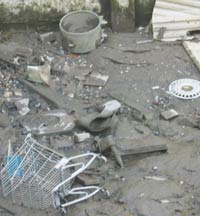
Picture, right:
Fly-tipping affects coastal regions and rivers, too. Rubbish in water sources can be a hazard to wildlife as well as to human users. This messy scene was photographed at low tide on the river Orwell, near the centre of Ipswich, UK.
Fly tipping and other ways of littering
Littering and fly-tipping by informal traders and individuals can be a source of pollution.
Even big companies can be responsible for quite a lot of unintentional rubbish. Near our local superstore the hedges are littered with "witches knickers" - the tattered remains of old plastic bags. These can be a threat to wildlife, as well as looking unsightly. Fast-food outlets are notorious for overflowing refuse bins and street litter which can attract rats.
Consumer products such as computers and old fridges contain hazardous components which need careful, controlled disposal. So when traders and individuals take short cuts to solve their waste problem, the wider environment is at risk.
Some of the refuse discarded may have serious pollutants in its make up, so this is not just a case of pollution as an eyesore.
Asbestos, household waste and vehicle parts are common waste materials found at pollution incidents, according to the UK Environment Agency.
Asbestos has been banned for years but is still being found from the time when its use was widespread in housing and brake-linings.
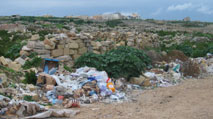
Picture above: Fly-tipping, here seen near a beach in Malta, looks unsightly
What are the effects of land pollution
Land pollution can have many effects upon us and upon animals and wildlife. Also many land pollutants can wash into water sources such as rivers and reservoirs.
See here for more on water pollution
Here are some of the main health concerns for humans.
Skin problems, respiratory problems, birth defects and cancers can all be caused by some of the most serious pollutants.
Toxic pollutants can get into our bodies directly through skin contact or by breathing in particles or dust. Some pollutants can get into our systems indirectly from eating vegetables grown in contaminated soil.
Industrial pollution causes land pollution:
What can we do to prevent land pollution?
Which cause of land pollution is the most urgent depends to some extent upon who you are and where you are.
Here are a few ideas for things we can do to prevent or reduce land pollution.
We can make sure that our personal litter is disposed of properly.
We can make sure that domestic items which are no longer needed are reused if possible and if they are beyond use they are recycled. Many modern consumer items such as batteries and CFL lights need proper disposal; chucking them into the rubbish bin is no longer enough.
We can support companies which have a strong ethical and well thought out approach to recycling and waste disposal.
We can buy our food from local, organic sources where possible and so reduce the use of pesticides and pollution from transport sources.
We can make sure that all the packaging we receive when buying new goods gets properly recycled.
Most municipal councils run recycling facilities these days.
There are charities which will recycle or reuse many domestic goods in urban areas. Some will even collect heavy items. Here in the UK Freecycle offers a service where people can give or take freely offered goods.
If you believe that the ground beneath your feet is polluted with industrial waste, you will probably have a struggle on your hands to get recognition of accountability from the bodies responsible. These are political issues beyond the scope of this site.
However, there are many companies now which specialise in testing and cleansing polluted post-industrial land. You should certainly take professional advice and look to your government and regional authorities for help where possible.
Most developed nations and many developing nations now have organisations dedicated to informing the public about pollution issues, advising industry and businesses and analysing risks and effects of contaminants.
For example, if you are a citizen of Canada, your first resource would probably be The National Pollutant Release Inventory (NPRI) which distributes information on releases, disposal and recycling of more than 300 pollutants from over 8,000 industrial or commercial facilities across Canada.
*****
Sponsored links
Industrial Pollution Causes Land Pollution - TOP
Industrial Pollution Causes Land Pollution
Copyright Greenfootsteps.com 2007
Please do not copy without permission.

| Tweet |
 Subscribe to the blog


| Tweet |

Sponsored links
On other pages
Footprints
- an occasional e-zine from Greenfootsteps
If you would like to receive the e-zine, please just sign up below.

New! Comments
Have your say about what you just read! Leave me a comment in the box below.